
To many investors, Private Equity and Private Credit carry an air of mystery and even excitement, given their highly compelling returns and restricted access. This attitude is not surprising, given that currently only slightly more than 3% of individual investors have invested meaningfully in private markets, compared to 57% for institutions such as endowments.
Meaningful Investment in Private Markets
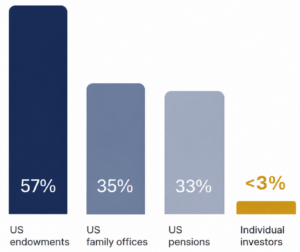
Source: Blackstone
The Growth of Private Markets
Private markets have continued to grow in recent years, with many companies opting to remain private for longer. Many argue that this makes a case for private markets, as without exposure, investors may miss out on large swaths of the market. The continued growth of private market funds has led to a search for new capital, leading to an expansion into 401(k)s and other defined contribution plans, representing an almost $14 trillion market. The growth of the investor base is further supported by new private market investments for non-qualified investors beginning to hit the market.
This expansion comes as a direct result of an executive order aimed at “democratizing access to alternative assets.” This was followed by a new rule from the Department of Labor that gives plan fiduciaries “safe harbor” to include private assets. The shift to allow private market investments into 401(k)s is still in its early stages, with limited allocations typically within the often-default Target Date Funds, which critics argue may not be suitable for all investors.
Number of US-listed Public Companies
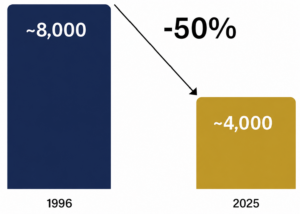
Source: World Federation of Exchanges, as of December 31, 2025
Why Private Markets?
Historically, private equity has outperformed public stock market benchmarks over long-term holding periods. However, this performance is heavily reliant on manager selection. In private equity, unlike traditional funds, manager outperformance is persistent, and the top funds more often remain at the top.
Private markets also act as an important pillar of diversification within a portfolio given their lower correlation with public markets and often distinct characteristics. Research has even shown that the inclusion of private market investments in a portfolio can increase overall return and reduce risk. However, this result must be taken with a grain of salt given that private market investments are typically not priced daily and therefore have artificially lower volatility.
Hypothetical 10-year Risk/Return
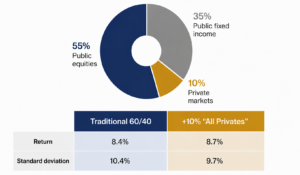
Source: Wellington Management
The Downsides
While there are numerous positives, investors in private markets should be aware that they are often illiquid, have higher fees, less transparent pricing, and more limited disclosures. These factors reinforce the need for rigorous and disciplined due diligence in selecting the appropriate strategies, as well as being a source of potential concern for unaware investors in their 401(k)s.