
We’ve received quite a few questions about SpaceX’s upcoming IPO, so we thought it would be helpful to put together a brief overview of what investors should know and some important factors to consider before participating.
Our goal is simply to provide helpful information, not to make a recommendation for or against investing in SpaceX.
This Friday, June 12th, we are set to see the largest-ever initial public offering (IPO), with the IPO of SpaceX (SPCX). SpaceX is seeking to raise $75 billion via 555,555,555 shares priced at $135 each, with the potential to sell additional shares if needed for a total of $85.7 billion. This represents 4.2% of the company, with the remaining 95.8% held by CEO Elon Musk, other insiders, and outside investors.
This valuation is unprecedented for an IPO, setting SpaceX at a market cap of $1.785 trillion, which would already make it the 8th largest company globally. To further add to the excitement, SpaceX, in a break from the norm, is opening up its IPO to more retail investors through participating brokerage platforms. Even going as far as to establish a website dedicated to its upcoming IPO, SpaceXIPO.
Considerations for Participation
The excitement surrounding SpaceX is not without reason. SpaceX has revolutionized our entire space industry and, by all accounts, appears to be a great company, although not yet profitable. However, as investors, it is important to be aware that excitement and the quality of the company do not always equate to being a good investment.
SpaceX’s unprecedented IPO valuation puts the company at over 90 times sales, which makes it 48% more expensive than the most richly valued tech stock in the S&P 500. This high valuation leaves little room for error and increases the likelihood of underperformance in the long term.
History would suggest that while SpaceX’s stock could see strong initial demand and potentially trade higher after an IPO, newly public companies often go through a more volatile adjustment period once the initial excitement fades and lockup restrictions begin to expire.
As shown in the chart below, the previous ten largest IPOs have, on average, underperformed the S&P 500 by 96 percentage points since their debut, with only two out of ten outperforming the index. That does not mean SpaceX would follow the same path, especially given the uniqueness and quality of the business, but it does highlight the broader risk that even very high-profile IPOs can struggle to meet elevated expectations once they begin trading publicly.
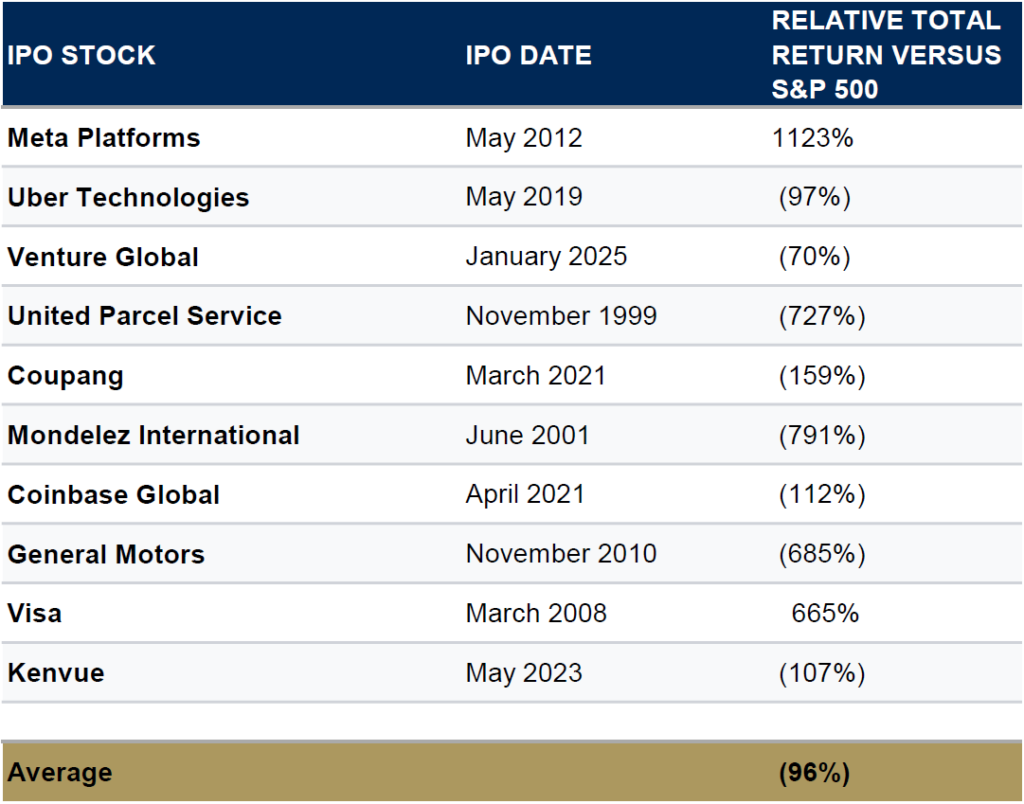
Data Source: Barron’s, YCharts. The chart shows performance relative to the S&P 500 for the 10 largest US IPO stocks (excluding foreign issuers) since their listing.
Final Thoughts
Taking a moderate position in SpaceX within a diversified portfolio, if desired, is not without merit and can make sense, as there are major potential upsides to the investment. Conversely, being aware of the risks and financials is also important, even if we often see markets that are divorced from investment fundamentals.