
As portfolios grow, investors often ask, “How much income can I expect from my portfolio?” A natural thought is that the portfolio should be made up of high-dividend-paying stocks and income-producing bonds to best meet consistent withdrawal needs or desires. While this strategy may have been the traditional approach in the past, does it still hold up today?
The Role of Dividends
Earlier in the year, we discussed the role that dividends play in a prudent investor’s portfolio. We found that while moderate dividends are most often a good sign in larger, established companies, they can create tax drag in portfolios, and corporations have more tax-efficient ways to return capital, such as share repurchases.
The Tax Question
The primary inefficiency of dividends is tax drag: the cost of paying taxes on income right away rather than at a time of your choosing with a timed, targeted sale of an asset. Think of it as a small leak in the portfolio. Even when considered “qualified” (generally paid out by U.S. companies and taxed more favorably than international dividends), dividends represent a forced tax event when held in non-retirement accounts. Namely, a dividend is a partial liquidation of your holding that is taxed immediately. In contrast, price growth lets you control when you sell (if ever), and thus when you pay taxes, which supports uninterrupted compounding of your wealth.
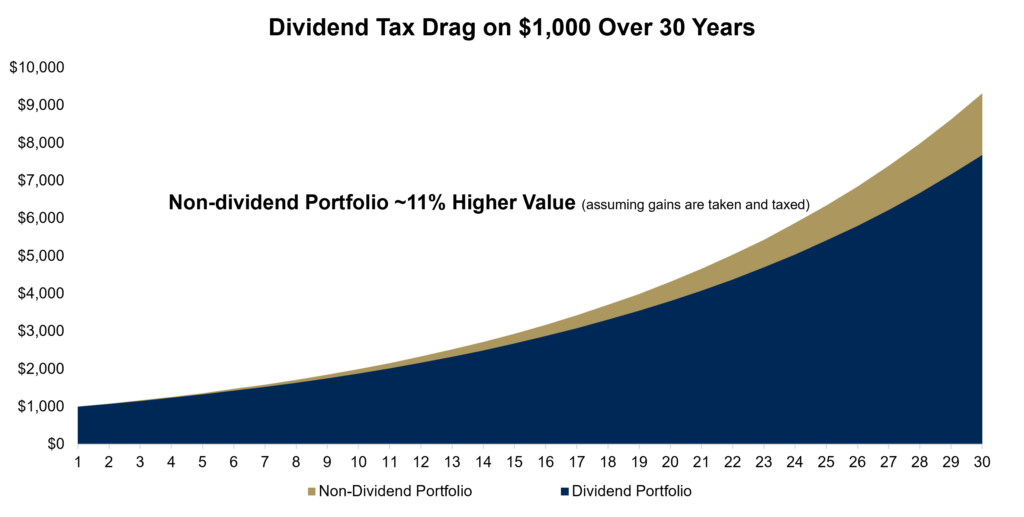
Hypothetical Illustration: $1,000 earning an 8% total return vs. 5% price appreciation & 3% dividend over 30 years. Assuming all dividends are qualified and facing a tax rate of 20% + NIIT(3.8%). Capital gains are taxed in year 30 at 23.8%. If gains are not taken, the difference in value is ~21%. NIIT= Net Investment Income Tax.
Strategic Takeaway
Ultimately, dividends are an important signal for investors, but they are only one consideration in constructing a portfolio, not the core foundation. Instead, an emphasis on total return, in conjunction with targeted investment sales to meet withdrawals, tends to provide the most tax-efficient results.
Bonds Are Back?
If dividends aren’t always the optimal means of earning portfolio income, does that mean that bonds are? The new market environment of elevated rates has driven bond yields to near multi-decade highs, with enhanced income potential causing many investors to re-evaluate the role of bonds in their portfolios.
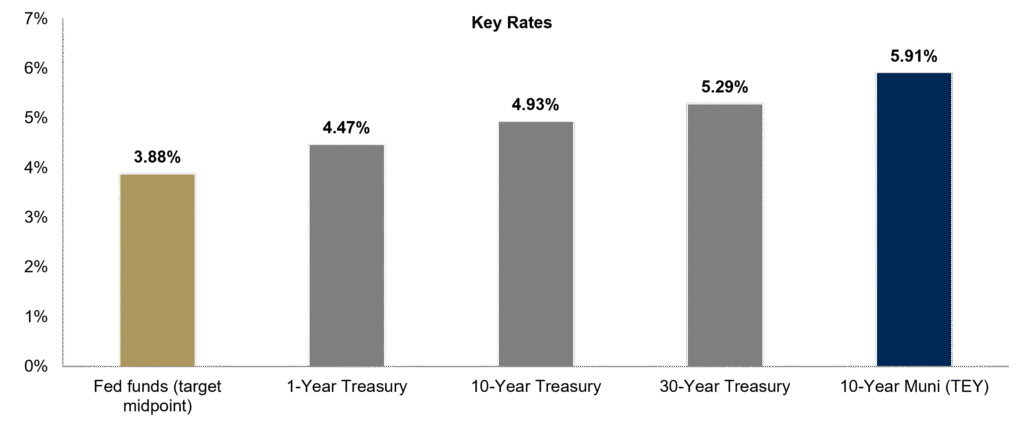
Source: Federal Reserve, CNBC, Muni yield: 10-yr AAA national 3.50% as of Oct 29, 2026 (FMS Bonds market yields. Treasury Yields are intraday as of 10/30/2026. 10-Year Muni TEY calculated with top federal bracket; no state tax assumed (37% + 3.8% NIIT = 40.8%). TEY = Tax Equivalent Yield.
The forward-looking income potential from bonds has meaningfully increased, and yet their return potential still remains below projected returns for stocks. This shouldn’t be a surprise, as these two asset classes are incorporated into a portfolio for different reasons, in particular because they often behave differently from each other and because bonds act as a more stable component of the portfolio relative to stocks. This difference is especially important during market downturns, as bonds can be sold to make withdrawals rather than being forced to sell stocks at a significant loss.
Inflation
All portfolio returns and income are subject to the hidden tax of inflation. Thus, a prudent investor looking to the future should place their focus on the expected real return potential of their portfolio, which is the investment return adjusted for inflation. While there are many hedges for inflation and returns can vary over shorter time periods, stocks have proven themselves to be among the best hedges against inflation.
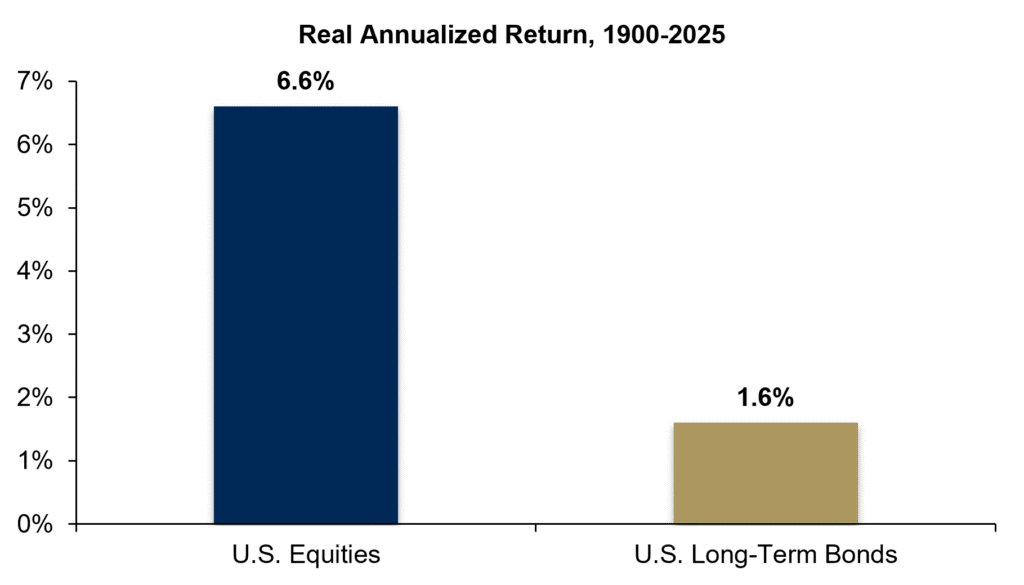
Source: UBS Global Investment Returns Yearbook 2026, DMS Database 2026.
Strategic Takeaway
The higher return of stocks is accompanied by higher risk relative to bonds, which means that many investors will own a customized mix of the two assets. Today’s higher yields are a promising sign for long-term investors and an indication that bonds are once again beginning to fulfill their intended role within the portfolio. So while bonds are certainly more attractive at the moment than in recent years, that doesn’t mean it’s time to pile into bonds and ditch stocks.
Summary
Focusing solely on income is rarely the optimal approach in constructing a portfolio intended to meet your withdrawal goals. Investors should instead build a portfolio allocation that aims for the highest risk-adjusted total return relative to their objectives and risk tolerance. Then they can make targeted sales of their assets to fulfill withdrawals, together with any portfolio income, for a more tax-efficient outcome.